An Interactive Guide to Bloom Filter
Discover the space-efficient Bloom filter, its workings, hash functions, tuning, and varied applications from database optimization to spam detection

Introduction
A Bloom filter is a space-efficient probabilistic data structure used to test whether an element is a member of a set. It saves us from performing expensive queries against our database. While Bloom filters can guarantee that an element is not in the set, they cannot guarantee its presence. Instead, they can sometimes return false positives (indicating an element is in the set when it is not), but they never return false negatives.
Problem
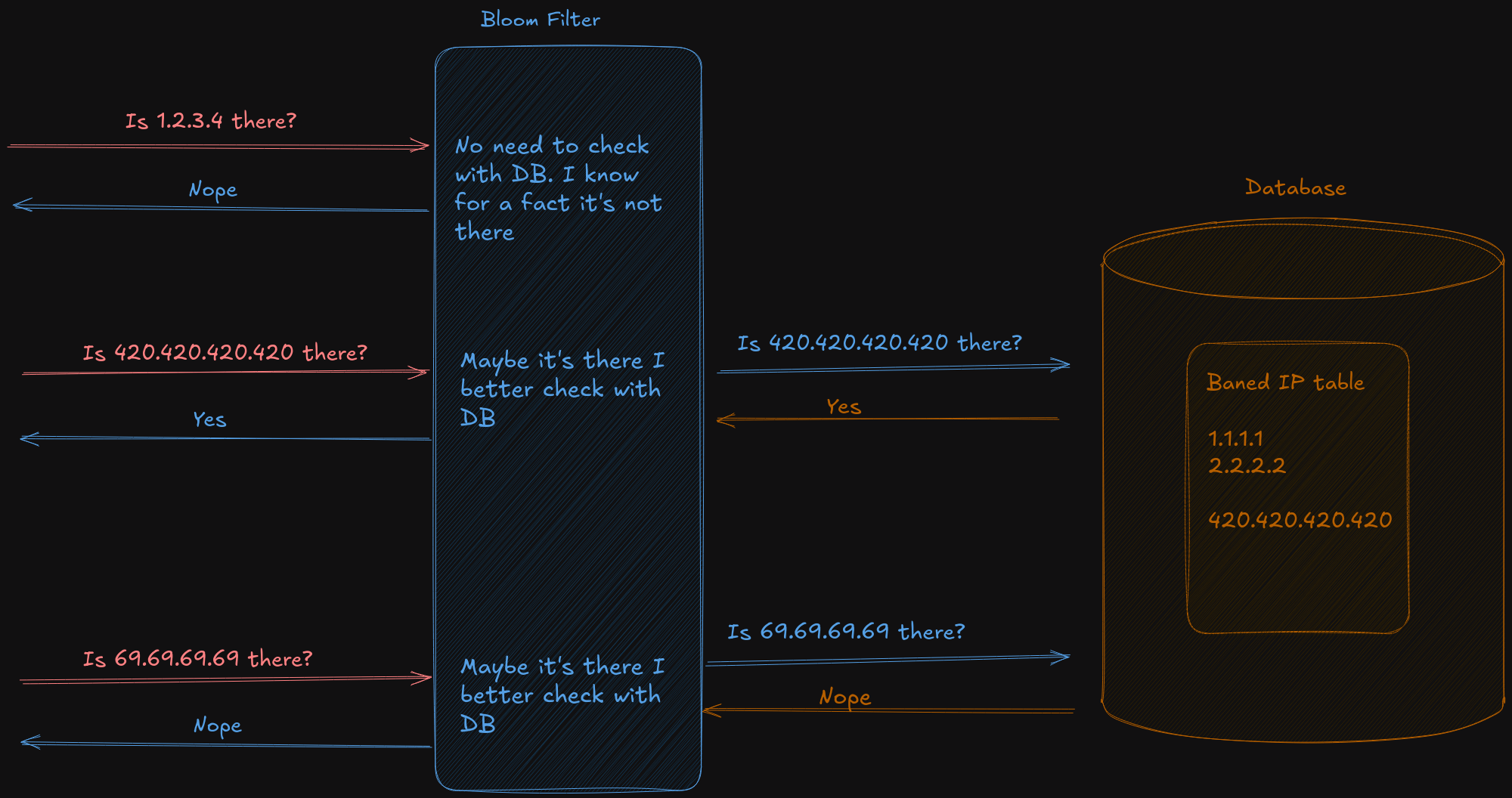
Before diving into how Bloom filters work, let’s consider the problem they solve. Imagine you run a website that needs to process thousands or even millions of requests every second. One of your tasks is to check whether the IP address making a request is in a list of banned IPs.
If you store this list in a traditional database or an in-memory data structure like a hash table, every lookup consumes resources, and lookup time can grow with the size of the list. For every incoming request, querying the database or searching through a large list can severely impact performance.
Wouldn’t it be great if there was a fast, constant-time way to determine whether an IP address is banned without querying the database? Enter Bloom filters.
Prerequisites
Hashing
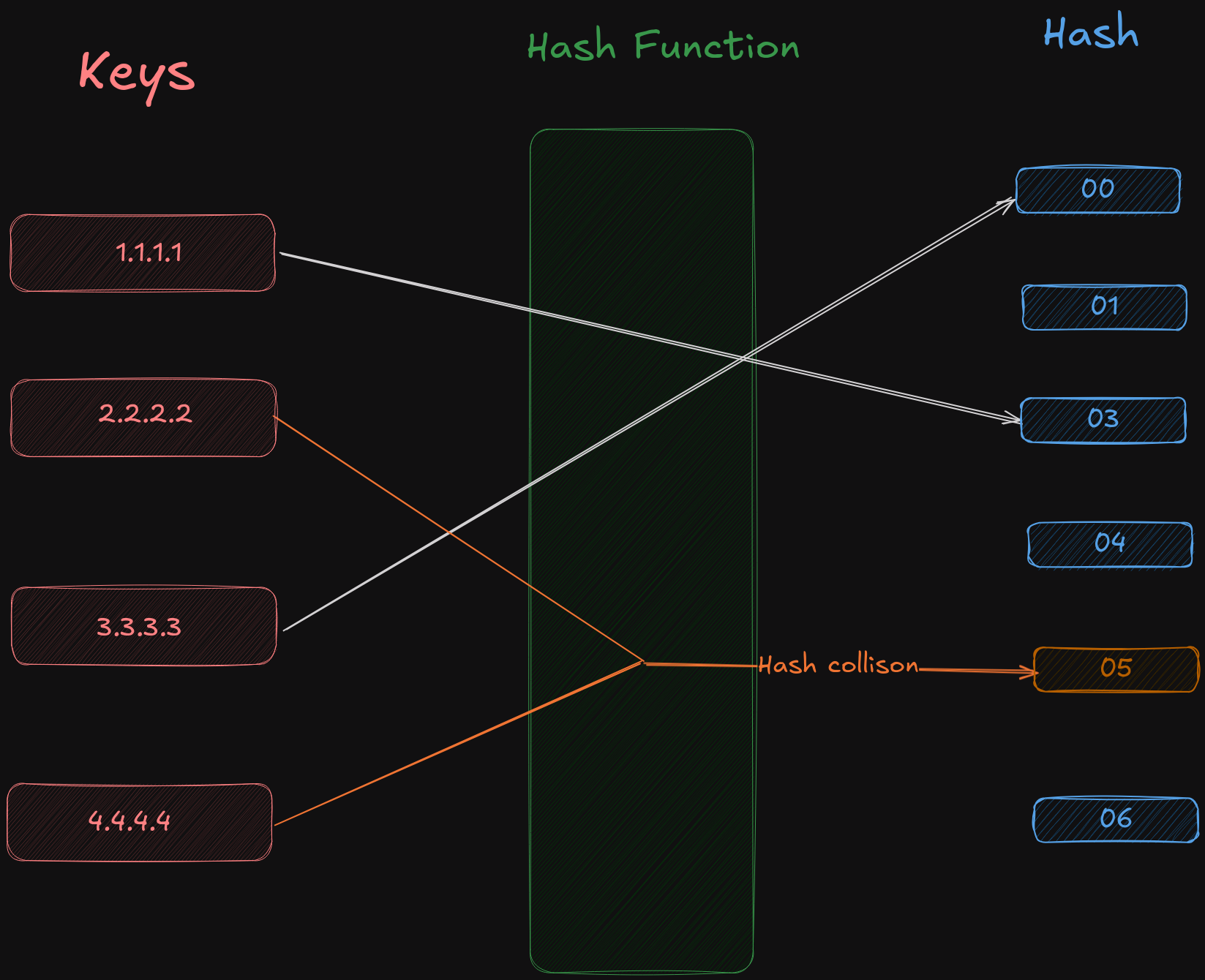
To understand Bloom filters, you need to be familiar with the concept of hashing. Hashing involves using a hash function to convert input data (like an IP address) into a fixed-size output, often an integer. Good hash functions are deterministic (they always produce the same output for the same input) and uniformly distribute outputs across the available range.
How It Works
Bloom filters address the problem of fast membership checks by using multiple hash functions and a bit array. Here’s how it works:
-
Initialization: A Bloom filter uses a fixed-size bit array of size
m, initially set to all zeros. It also useskindependent hash functions. -
Adding an element:
-
To add an element, it is passed through all
khash functions. -
Each hash function maps the element to a position in the bit array, and the corresponding bits at these positions are set to
1.
-
-
Checking for membership:
-
To check if an element is in the set, the element is hashed with the same
khash functions. -
If all the bits at the positions indicated by the hash functions are
1, the filter reports that the element might be in the set. -
If any of these bits are
0, the element is definitely not in the set.
-
This design ensures that the Bloom filter is both space-efficient and fast ( time complexity). However, there is a trade-off: the possibility of false positives, which occurs when bits set by previously inserted elements overlap, making it appear that a new element is in the set when it has never been added.
I have created a fun little app that lets you play with a Bloom filter interactively:
-
See what happens when you fill the filter with all ones.
-
Can you get the Bloom filter to return a false positive?
-
Notice how increasing the number of hash functions fills up the filter faster.
-
Notice how decreasing the number of hash functions affects the false positive probability.
Tuning
I have made another fun little app that lets you experiment with the parameters of a Bloom filter:
-
Number of elements
N -
Size of filter
M -
Number of hash functions
K
Some conclusions you can draw from the graphs for a well-designed filter:
-
False positive rate vs. number of items follows a logistic curve (increasing items gradually saturates the filter).
-
False positive rate vs. number of hash functions follows a U/J-curve (too few or too many hash functions increase false positives).
-
False positive rate vs. filter size decreases inversely as more bits are allocated.
Formulas
1. Probability of a False Positive
The probability of a false positive in a Bloom filter is approximately:
Where:
-
m: Number of bits in the Bloom filter. -
k: Number of hash functions. -
n: Number of elements inserted into the filter.
2. Optimal Number of Hash Functions
The optimal number of hash functions k to minimize the false positive rate is:
3. Expected Fraction of Bits Set to 1
The fraction f of bits in the Bloom filter that are set to 1 after n insertions is:
Alternatives and Variations
-
Cuckoo Filters
A modern alternative that supports deleting inserted items. It stores fingerprints of inserted items in an array of buckets using cuckoo hashing. It works great for applications needing high lookup throughput, deletions, or large-scale deduplication.
-
Counting Bloom Filters
Uses a counter array where each position is a small integer instead of a single bit. Lookups, insertions, and deletions are performed by incrementing and decrementing the counters. Works great for applications that require element deletions while maintaining high performance and bounded memory usage.
Applications
Bloom filters have a wide range of real-world applications, including:
-
Database Query Optimization: Reduce disk I/O and lookups by quickly discarding queries for non-existent elements (e.g., in Cassandra, RocksDB, and PostgreSQL).
-
Web Caching: Quickly check if a URL is cached before attempting to fetch it from disk or remote storage.
-
Spam and Malicious URL Detection: Fast pre-checks to determine whether an email sender or URL is present on a blacklist.
-
Distributed Systems: Avoid unnecessary cross-node synchronization and identify duplicate data or requests efficiently.