An Interactive Guide to Caching Strategies
Explore popular caching strategies for improved application performance, including Cache-Aside, Read/Write-Through, Write-Back, and more

Introduction
The word cache originates from the French word cacher, meaning to hide. Outside computer science circles, it refers to a hidden storage place, typically for emergency supplies. In computer science, however, the concept is flipped: a cache is a high-speed storage layer used to store frequently accessed data close to the application. It is one of the most effective tools for improving application performance and reducing latency.
However, choosing the right caching strategy can be tricky. Each pattern has its own strengths, trade-offs, and ideal use cases.
Terminologies
-
Cache Hit: When the requested data is already present in the cache and returned immediately.
-
Cache Miss: When the requested data is not found in the cache, requiring a lookup from slower backing storage (like a database).
-
Asynchronous Writes: Writing updates to the database in the background without blocking the client or waiting for disk confirmation.
-
Eventual Consistency: A consistency model where replicas or backend stores are updated asynchronously, converging over time.
-
Cache Stampede (Thundering Herd): A scenario where a popular cached item expires, causing a massive surge of concurrent requests to hit the database simultaneously.
-
Cache Pre-Warming: Proactively loading frequently accessed data into the cache before user traffic arrives.
-
Cache Pollution: When rarely accessed or one-off data fills up the cache, evicting valuable, frequently accessed data and degrading performance.
In this guide, we'll explore five common caching strategies that every developer should understand.
Cache-Aside (Lazy Loading)
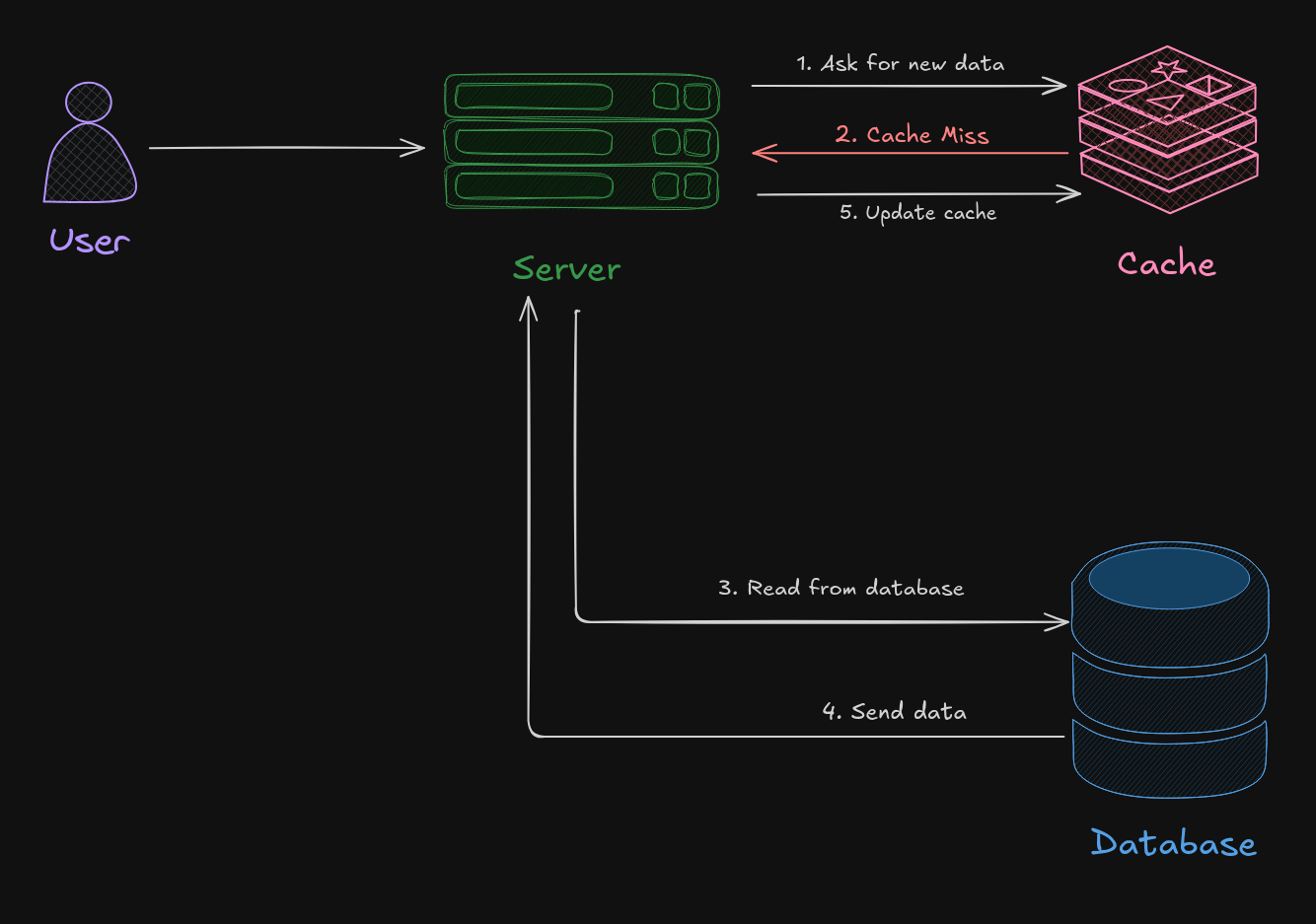
Introduction: The application code directly orchestrates both the cache and the database.
Cache Hit Behavior: Returns data directly from the cache.
Cache Miss Behavior: The application reads from the database, populates the cache with the retrieved data, and returns it to the client.
Write Behavior: Writes go directly to the database; the existing cache entry is invalidated or updated.
Consistency: Eventual consistency (stale data is possible if an invalidation fails or during concurrent updates).
Performance: Fast reads on cache hits; higher latency on cache misses.
Use Cases: Read-heavy workloads with unpredictable or uneven access patterns.
Advantages: Simple to implement; resilient to cache outages (the application can fall back to querying the database directly).
Disadvantages: Susceptible to cache stampedes; caching logic must be duplicated across multiple services.
Link to interactive app
Read-Through
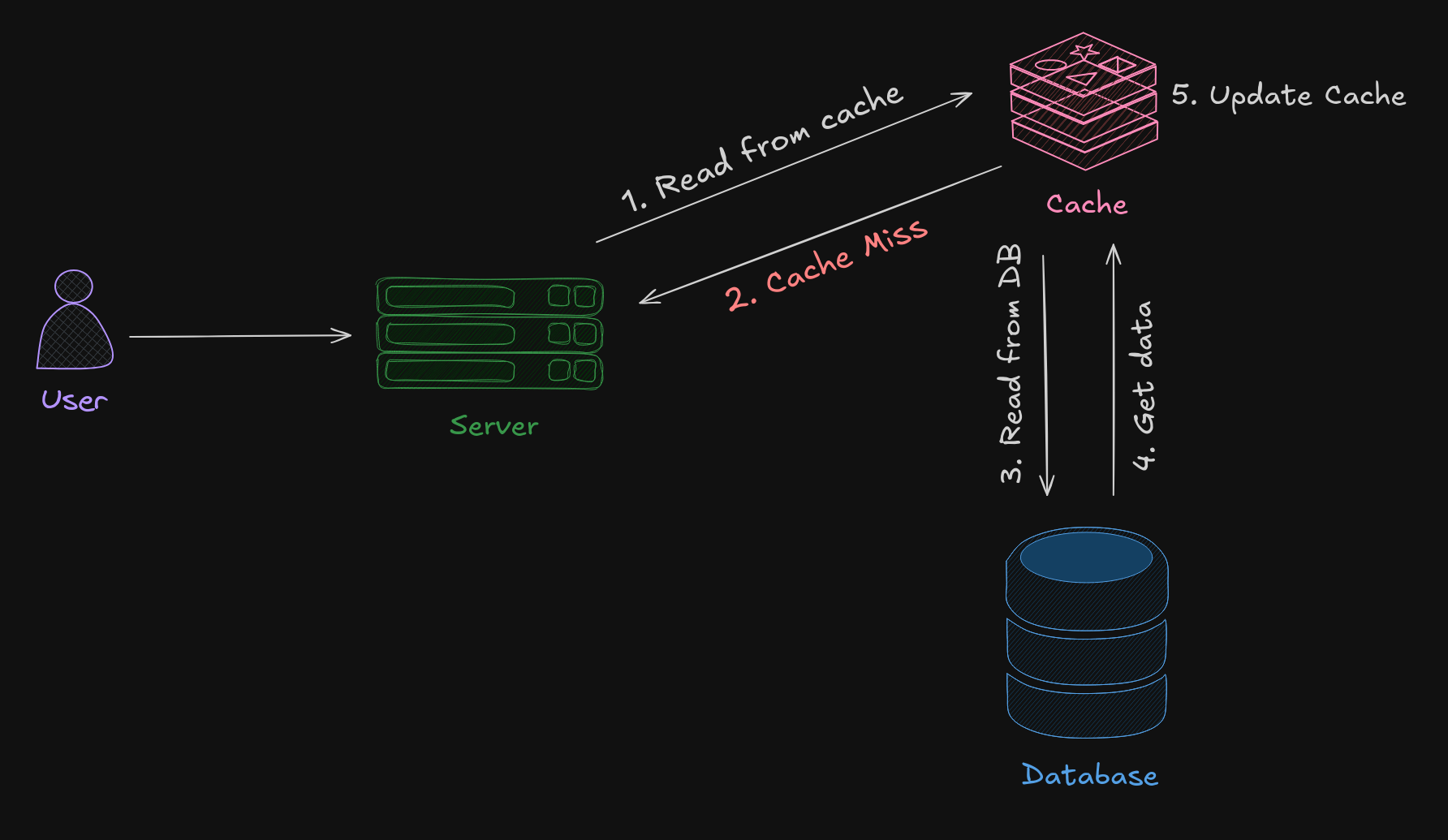
Introduction: The cache abstraction acts as the primary data interface for reads, managing database queries transparently.
Cache Hit Behavior: The cache returns the data directly.
Cache Miss Behavior: The cache loads the missing data directly from the database, stores it, and returns it to the application.
Write Behavior: Typically paired with Write-Through or Write-Back strategies.
Consistency: Governed by the accompanying write strategy.
Performance: Consistent, predictable read performance.
Use Cases: Applications with uniform, standardized data access patterns.
Advantages: Simplifies application logic by centralizing caching code in the data access layer.
Disadvantages: Less flexibility in custom query caching; the caching layer becomes a critical single point of dependency.
Link to interactive app
Write-Through

Introduction: Writes are sent to the cache, which synchronously writes data to the backing database before acknowledging completion.
Cache Hit Behavior: Returns cached data immediately.
Cache Miss Behavior: Fetches missing data from the database into the cache.
Write Behavior: Writes to both the cache and the database synchronously before confirming success to the client.
Consistency: Strong consistency; the cache and database remain strictly synchronized.
Performance: Slower write operations due to dual synchronous writes; fast subsequent reads.
Use Cases: Financial systems, order management, and critical inventory counters where stale reads cannot be tolerated.
Advantages: Guarantees data freshness with zero risk of stale reads; reliable fault recovery.
Disadvantages: High write latency; writes that are never read consume cache memory unnecessarily.
Link to interactive app
Write-Back (Write-Behind)
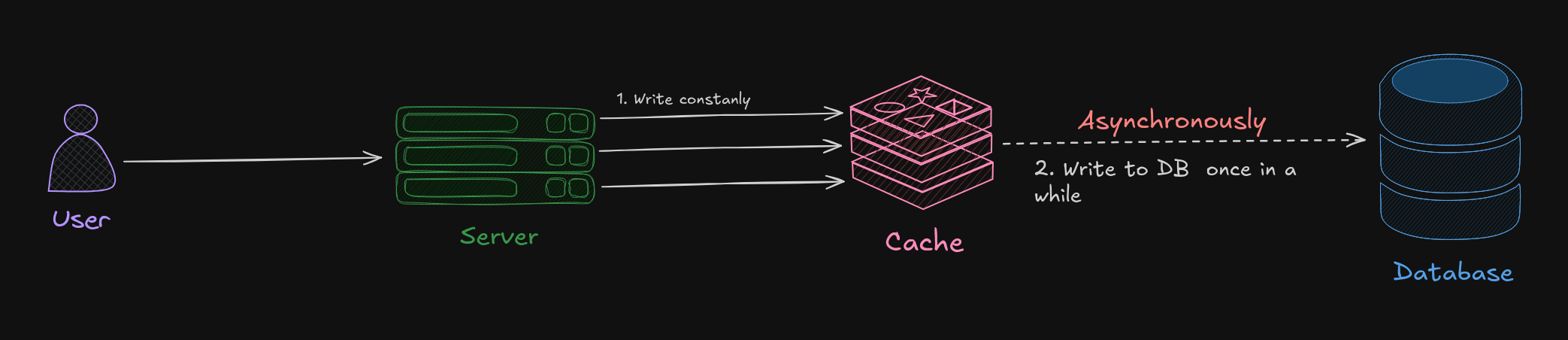
Introduction: Writes are acknowledged immediately upon saving to the cache, and asynchronously flushed to the database in batches.
Cache Hit Behavior: Returns cached data immediately.
Cache Miss Behavior: Loads from the database if not currently pending in the write queue.
Write Behavior: Updates the cache instantly; batches and delays writes to the persistent database.
Consistency: Eventual consistency (the cache holds newer data than the database temporarily).
Performance: Extremely low write latency and high write throughput.
Use Cases: High-throughput logging, telemetry, real-time analytics, and chat activity counters.
Advantages: Outstanding write performance; drastically reduces load on the primary database via write-coalescing and batching.
Disadvantages: Risk of data loss if the cache node crashes before pending writes are flushed to disk; complex failure handling.
Link to interactive app
Write-Around
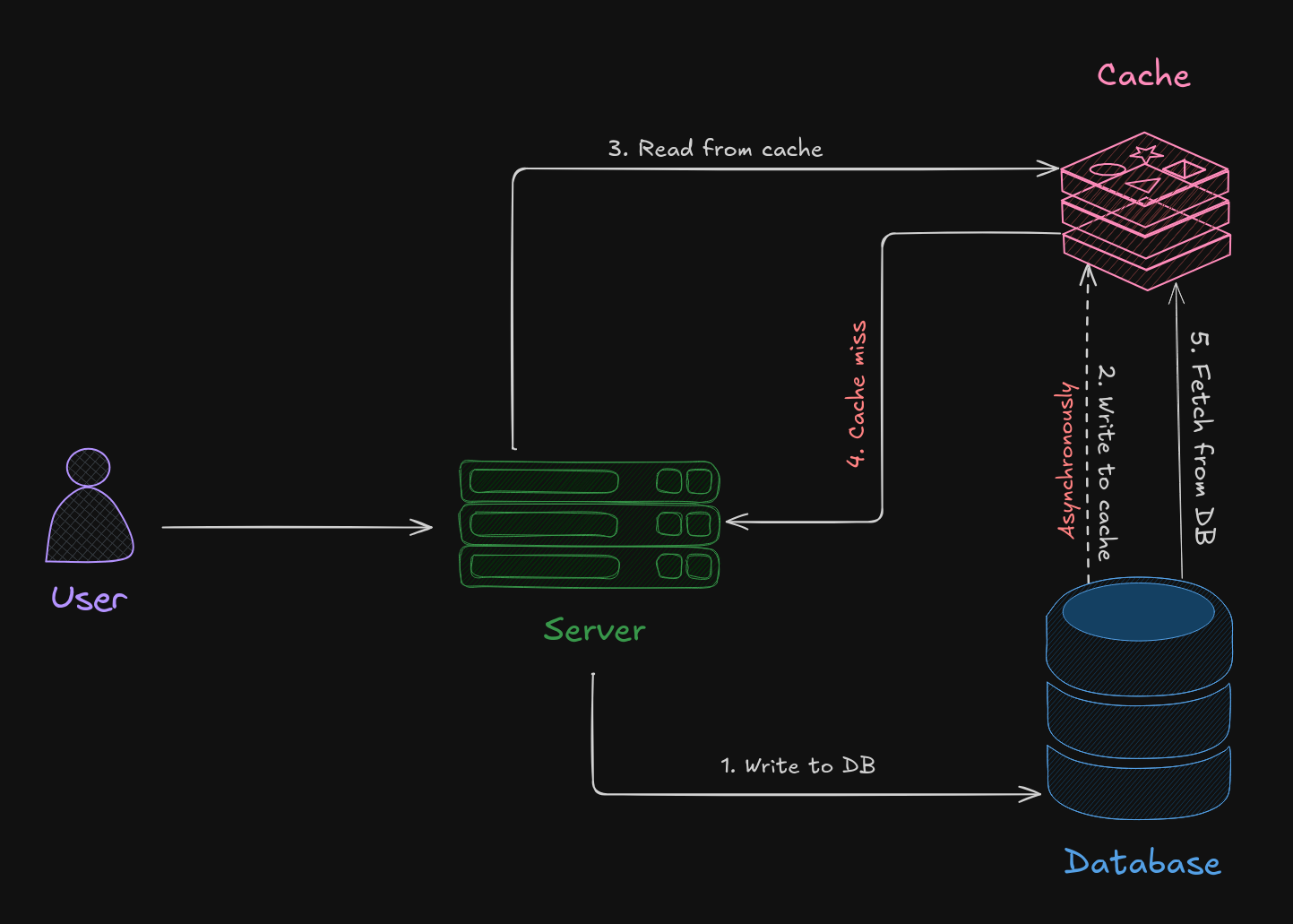
Introduction: Writes bypass the cache entirely and are committed directly to persistent storage.
Cache Hit Behavior: Returns cached data.
Cache Miss Behavior: Loads data from the database on demand and populates the cache.
Write Behavior: Writes directly to the database without modifying or pre-populating the cache.
Consistency: Prevents cache pollution from write-only or infrequent data.
Performance: Fast writes; the first read after a write incurs higher latency (cache miss).
Use Cases: Bulk data imports, audit trails, and archival logging where written data is rarely read right away.
Advantages: Prevents cache pollution; eliminates write overhead for cold data.
Disadvantages: Initial reads after writes are slower.
Link to interactive app
Refresh-Ahead
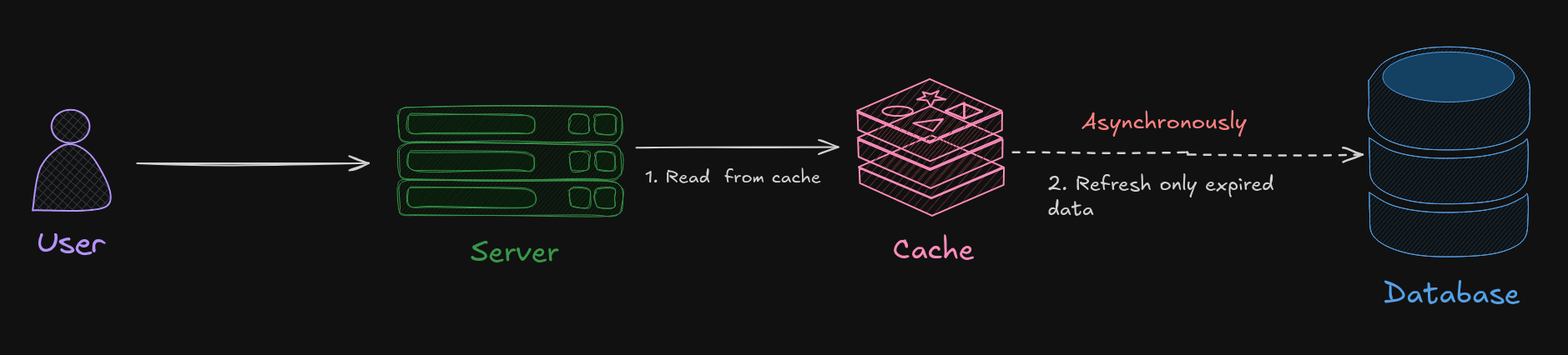
Introduction: Automatically reloads cached data from the database before its Time-To-Live (TTL) expires.
Cache Hit Behavior: Almost always returns fresh data with minimal read latency.
Cache Miss Behavior: Rare; typically occurs only during initial cache warmup.
Write Behavior: Depends on the underlying paired write strategy.
Consistency: Near real-time freshness without manual invalidation.
Performance: Consistently fast read latency across all requests.
Use Cases: Hot keys, trending leaderboards, product catalogs, and predictable recurring queries.
Advantages: Prevents cache misses and eliminates latency spikes for end users.
Disadvantages: Can waste database resources if the pre-fetched data is not actually requested; requires accurate access prediction logic.
Link to interactive app
Conclusion
As these interactive demos demonstrate, picking the best caching strategy depends heavily on your access patterns and consistency requirements. These strategies are not mutually exclusive—real-world production architectures often combine them:
Here are some architectural recommendations:
Content Management Systems (CMS)
Recommended: Write-Through + Read-Through
Rationale:
- Ensures newly published articles and pages are immediately consistent and readable.
- Centralizes caching logic away from presentation microservices.
- Provides strong consistency for editor updates.
E-Commerce Product Catalogs
Recommended: Cache-Aside + Refresh-Ahead
Rationale:
- Cache-Aside offers flexible on-demand caching for large product catalogs with long-tail access patterns.
- Refresh-Ahead keeps top-selling items and landing page deals permanently warm and fast.
Financial and Trading Systems
Recommended: Write-Through
Rationale:
- Strict data integrity and zero-loss guarantees are mandatory.
- Every ledger transaction must be persisted immediately before confirmation.
- Cache serves exclusively to reduce read latency for downstream analytics.
Real-Time Chat Applications
Recommended: Write-Back + Read-Through
Rationale:
- Write-Back handles massive bursts of message writes efficiently.
- Read-Through transparently fetches chat history if older messages are requested.
- Active conversation state remains in fast in-memory cache.
Gaming Leaderboards
Recommended: Write-Back + Refresh-Ahead
Rationale:
- Write-Back absorbs high-frequency score increments in real time.
- Refresh-Ahead periodically syncs and serves global top-100 player leaderboards with near-zero latency.
- Eventual consistency across follower views is fully acceptable.
API Rate Limiting & Metrics
Recommended: Write-Back
Rationale:
- Tolerates extremely high update frequencies at minimal latency.
- Minor variance/data loss during catastrophic failover is acceptable compared to gateway latency.
- Keeps the critical path of API gateways fast and responsive.
Start simple with Cache-Aside, measure your cache hit ratios and latency metrics, and evolve your caching architecture as your application scales. Happy caching!